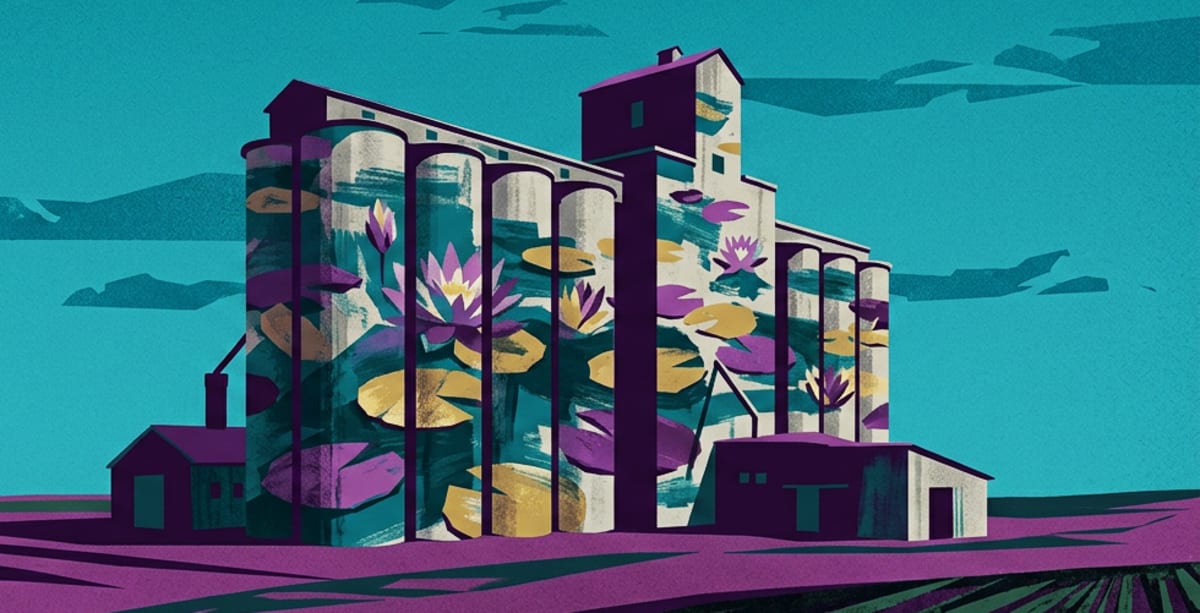
The painted elevators? We wish those were real.
The Origin Legend
If you’ve ever driven into Monet, Kansas for the first time, you already know the moment I’m talking about.
You’re out on the flat, the road stretching ahead of you like someone laid it down with a ruler, and then — there they are. Rising up out of the prairie like they have absolutely no business being there. Grain elevator towers painted in water lilies and haystacks and poplar trees bending in an impressionist wind. Claude Monet, circa 1890, reproduced in the middle of the Kansas plains on the side of working agricultural infrastructure.
It stops people cold the first time. I’ve seen it happen.
Here’s the part most people don’t know: it wasn’t a city project. It wasn’t a tourism board initiative or a grant-funded arts commission. It was a group of women who looked at a cluster of concrete towers dominating their town’s skyline and decided, collectively, that they could be something more.
They called themselves the Water Lily Society.
It was the mid-1960s. The cooperative had been the economic backbone of Monet for decades by then — grain in, money out, repeat. The elevators were functional and enormous and about as beautiful as a filing cabinet. The women who founded the Water Lily Society were mostly co-op wives, which is to say they were women who understood exactly how much those towers meant to the town and felt perfectly entitled to have an opinion about what they looked like.
The idea, as best as local history records it, was simple: if you’re going to have something that size on your skyline, make it worth looking at.
The execution was considerably less simple.
Getting permission took the better part of a year. Getting the paint took longer. Finding artists willing to work at that scale, on curved concrete surfaces, in Kansas wind, for what the Water Lily Society could actually pay — that was its own particular adventure. There were town council meetings. There were husbands who thought it was impractical. There were neighbors who thought it was frivolous.
The Water Lily Society, by all accounts, smiled pleasantly and kept going.
The first panel went up in the summer. Water lilies — the obvious choice, the founding choice, the one that gave the Society its name. Monet’s floating gardens reproduced on the side of a grain elevator in the middle of the continent, visible from three miles out on a clear day.
The town lost its mind a little. In the good way.
The rest followed over the next few years. Haystacks. Poplar trees. The Japanese footbridge. Each one a different tower, a different season, a different angle of light. From the highway coming in from the east, on the right morning, you can see four of them at once and the effect is something that doesn’t have a practical word attached to it.
The Water Lily Society kept a small bronze plaque near the base of the original tower. It lists the founding members’ names in modest lettering. Most people who’ve lived in Monet their whole lives have never read it. The elevators are just part of the landscape now, the way anything extraordinary becomes ordinary once it’s always been there.
I think about those women sometimes. The particular stubbornness it takes to look at something purely functional and decide it should also be beautiful. The patience required to convince a town council. The audacity of the scale of the thing — not a mural on a shop wall, not a painted fence, but the tallest structures for miles in every direction, turned into art because a group of women decided they should be.
They didn’t do it for tourism, though tourism followed. They didn’t do it for recognition, though the plaque is there if you look for it. They did it because they lived here and they wanted something worth looking at when they came home.
Sixty years later, their town still has it.
I think that’s worth knowing.