Creating a New Place from an Old Memory
There's something nobody tells you about Kansas until you've driven it yourself.
It's flat. Really flat. The kind of flat that stops being a joke and starts being something else entirely once you're actually out on the road with nothing between you and the horizon but wheat fields and sky. You can see for miles in every direction. You can see storms coming from an hour away. You can see the water tower of the next town long before you reach it.
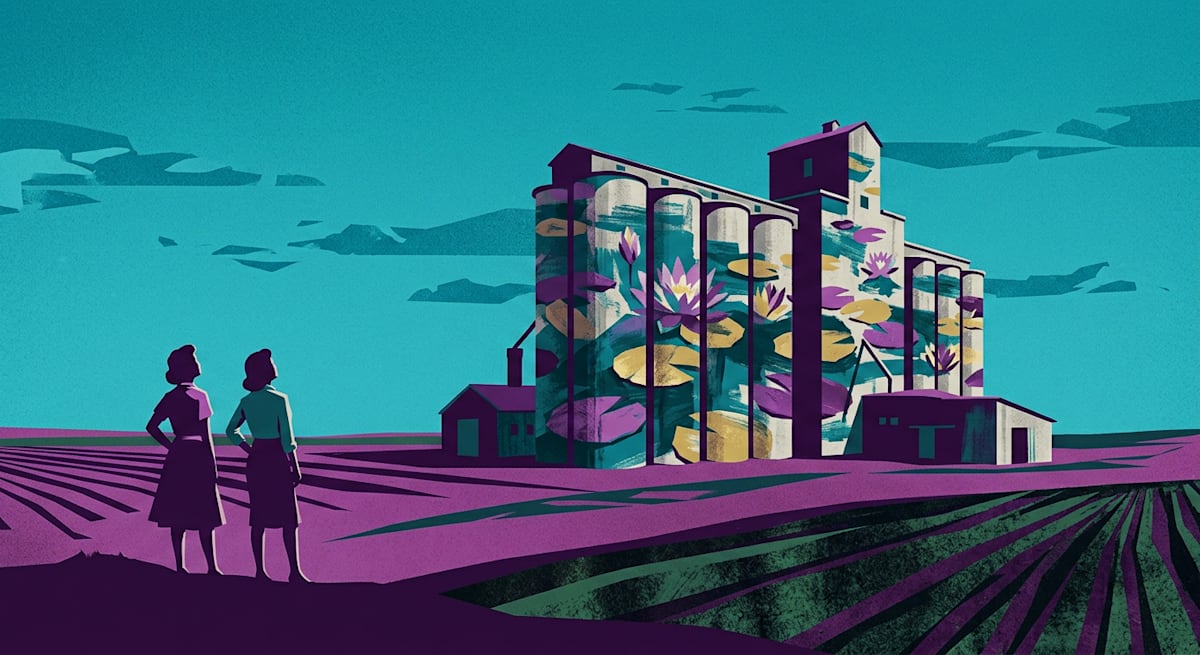
And if you're driving into Monet, you can see the grain elevators from three miles out.
They rise up out of the prairie without warning — tall and painted and absolutely impossible, Monet's water lilies and haystacks wrapped around working concrete like a dream someone decided to make permanent. On the right morning, with the light coming in low from the east, they're the first thing that catches the sun. You see them glowing before you see anything else.
I've watched a lot of people have that moment for the first time. The involuntary slowdown. The hand coming up toward the window. The thing they say, which is usually some version of I didn't expect that.
Nobody ever does.
But there's another version of that moment. The one that doesn't get talked about as much.
The one where you've seen them a thousand times. Where you grew up under their shadow and spent years wanting something bigger than what they represented. Where you made a decision — or a series of decisions, or maybe just let life make them for you — and drove away from Monet with those painted towers getting smaller in your rearview mirror.
What does it feel like to watch them disappear?
I've been writing a character who knows that moment intimately.
Her name is Blair Cole. She's a hairdresser, sharp as a pair of good shears, and she left Monet six years before the story I'm telling begins. She had her reasons. They made sense to her at the time, the way reasons always do when you're the one holding them. The night she left, she didn't look back at the elevators. She just drove.
I think about that a lot. The specific choice of not looking.
The thing about leaving a place like Monet is that it doesn't quite let you go. The town keeps existing without you. The elevators keep standing. The people you left behind keep living their lives, carrying pieces of your story that you're no longer around to correct.
And then something happens — it's always something, a phone call, a crisis, the particular pull of a place that knew you before you knew yourself — and you find yourself on that road again. Heading back. Watching the horizon.
Watching the elevators get bigger instead of smaller this time.
Blair makes that drive in my prequel story, Curling Iron Catastrophe — the story of the night everything fell apart and why she pointed her car away from Monet and didn't come back for six years. It's not a mystery. It's something quieter than that. A woman, a decision, and the particular weight of what gets left behind.
It's free when you subscribe to the newsletter. Because some stories are better told before the beginning.
The elevators are still there when she comes back. Of course they are. Sixty years and they haven't moved an inch.
There's something steadying about that, if you let it be.